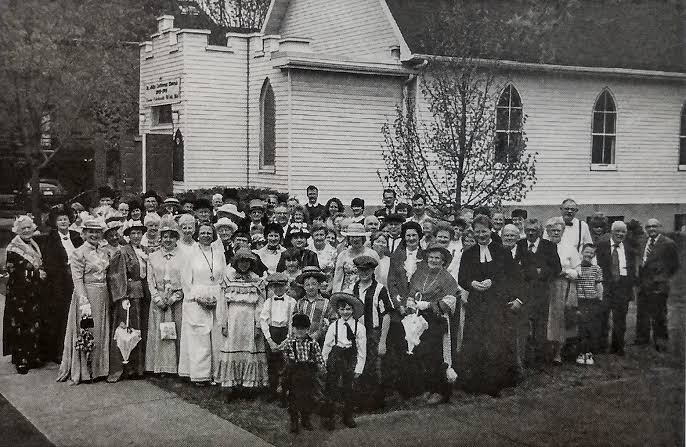
A History of Faith in the Heart of Texas
A History of Faith
Our History
St. John Lutheran Church, Dime Box
The story of St. John Lutheran Church began with a handful of families who shared a simple desire: a place to worship God, grow in faith, and teach their children about Jesus. From those early gatherings grew a congregation that has served the Dime Box community for generations.
Our Beginnings
Lutheran worship services began in the Dime Box area in 1909. Among the early families were Oswald Hannes, Henry Marburger, George Marburger, John Nimtz, and others whose faith and commitment helped lay the foundation for the congregation.
In 1911, the congregation was organized as St. Petri Lutheran Church, with Pastor William Mueller of Giddings serving as its pastor. A charter from the Texas Synod officially recognized the congregation in 1913.
Before having a church building of their own, members gathered wherever space was available. Services were held at Frog Hollow School on land owned by Frank Hannes, at Silver School about a mile west of Old Dime Box, and in a former saloon shared with other congregations. The Czech Moravian Brethren congregation also welcomed them into its church building in the Hranice community.
These early years reflected the dedication of people who understood that a church begins with a community gathered around God’s Word.
A Permanent Home
As the congregation grew, members began working toward a permanent place of worship. Families supporting this effort included the Bage, Buchorn, Buenger, Eichler, Etzel, Hannes, Karcher, Marburger, Nimtz, Riske, and Wolf families, along with many others.
On December 14, 1922, the congregation purchased land from the Burttschell family. The church building was completed and dedicated in 1923, becoming the first church built in the New Dime Box community. The first confirmation class was received on July 1 of that year.
Pastor Mueller served the congregation from 1911 until his retirement in 1942. He initially preached in German and later conducted services in both German and English. Church council minutes were also written in German until 1942, when the congregation began recording them in English.
In 1924, the congregation purchased a used organ in Giddings for $25. Selma Bage served as the first organist, helping establish a tradition of music in the congregation’s worship.
Teaching the Faith and Caring for One Another
Christian education became an important part of congregational life early in St. John’s history. In 1924, Martha Etzel, together with her daughters Nice, Ella, and Alta, helped establish a Sunday School.
Walter Buenger served as its first superintendent, followed by Earnest Marburger, who served for thirty years. Early teachers included Martha Etzel, Alice Etzel, Myrtle Harzke, Ruby Marburger, Gladys Nimtz, and Ruby Riske.
Even when worship services were held only on the third Sunday of each month, Sunday School met every Sunday. In 1942, Mame Burttschell began an adult Sunday School class, providing another opportunity for members to grow in their understanding of God’s Word.
Around the same time the children’s Sunday School began, Johanna Buenger and Mamie Karcher helped organize a Ladies Aid Society, bringing women together for fellowship and service.
The Church Cemetery
In 1924, Henry Marburger, whose wife was ill with tuberculosis, recognized the need for a cemetery where church members could be buried without charge. He helped arrange the purchase of two acres from Albina and William Blaha for $100 per acre.
The land was purchased on August 18, 1924, and designated as St. Petri Lutheran Cemetery. Offerings collected during just two worship services covered the cost of the land and a surrounding fence.
The congregation formed a Cemetery Association and appointed Ernest Wolf to oversee burial spaces for members and the sale of spaces to nonmembers. He served for more than fifty years before retiring in early 1988.
Anna Nimtz Marburger, who died in February 1925, was the first person buried in the cemetery.
During the early 1940s, the church and cemetery were renamed St. John Lutheran Church and St. John Lutheran Cemetery. The surviving history does not explain the reason for the change.
Pastors and Shared Ministry
For much of its early history, St. John shared a pastor with another congregation. These partnerships included Martin Luther Lutheran Church in Giddings, St. John Lutheran Church in Paige, and St. John Lutheran Church in Deanville.
Following Pastor Mueller’s retirement, pastors serving the congregation included Walter Tillmans, E. C. Poehlmann as a supply pastor, S. T. Schroeder, and interim pastors Doege and Haag.
Pastor J. Fred Mgebroff later came to the Giddings–Dime Box parish after serving in student ministry at Texas A&M University.
On August 4, 1957, newly ordained Pastor Elias Rode was installed to serve the Paige–Dime Box parish. Other pastors serving between 1957 and 1971 included Louis Kramer, Charles Brinkmeyer, Hilmer Krause as an interim pastor, Nick Bohman, and Lynn Zimmermann as a supply pastor.
In May 1971, Pastor Winston Hold was installed. A native of Lee County, he had been baptized by Pastor Walter Tillmans and confirmed by Pastor J. Fred Mgebroff at his home congregation, Martin Luther Lutheran Church in Giddings.
Making Room for a Growing Congregation
As membership and ministry grew, the congregation needed more space. On April 27, 1952, an annex was dedicated on the north side of the original church.
Oswald Marburger served as construction foreman, and congregation members donated their labor. The addition included a fully equipped kitchen, indoor restrooms, space for Sunday School classes, and folding doors connecting it to the sanctuary. Pastor Mgebroff was serving at the time, and former pastor S. T. Schroeder returned as the guest speaker for the dedication.
On August 13, 1972, the congregation held a special “three-in-one” celebration. The event recognized the congregation’s sixtieth anniversary in 1971, the church building’s approaching fiftieth anniversary in 1973, and extensive renovations completed in 1972.
Several former pastors returned to join Pastor Hold and the congregation in giving thanks to God and rededicating the church to His service.
Pastor Robert Braun served St. John during the late 1970s and early 1980s.
A New Church Building
By 1983–1984, the congregation recognized the need for a new church building. Construction began in June 1984, with Brad Cutright of La Grange serving as architect and Gaeke Construction Company of Giddings as contractor.
The first services in the new building were held in December 1984, and the building was dedicated in April 1985. Pastor Dale Ullested-Heneke was serving the congregation during this important chapter.
In 1985, St. John ended its shared parish arrangement, and Pastor Ullested-Heneke became the first pastor to serve the Dime Box congregation exclusively.
Continuing to Grow and Serve
Pastor Anne Kolmeier was installed in December 1985, becoming the first woman pastor called to serve in Lee County. She served until 1990, when Pastor David Bernshausen came to St. John.
In 1992, the congregation built a parsonage next to the church to provide a home for its pastor. Pastor Lee Eschberger was installed in 1997.
In 2003, St. John added a Sunday School building to provide more room for teaching, fellowship, and congregational activities. The building has also hosted Easter breakfasts, anniversary celebrations, family reunions, and other gatherings.
Pastor Randy Bruno served from 2006 to 2007. Ed Truelson served as lay pastor from 2007 to 2010. Following his ordination in 2010, Pastor Truelson continued serving the congregation until 2012.
Our Lutheran Fellowship
Over the years, St. John’s denominational relationships changed through Lutheran church mergers. The congregation’s early affiliation with the Texas Synod eventually led to membership in the American Lutheran Church and later the Evangelical Lutheran Church in America (ELCA).
Following concerns about changes in the ELCA’s approach to biblical teaching, the congregation voted to withdraw and join Lutheran Congregations in Mission for Christ (LCMC).
A Heritage of Faith and Welcome
As of January 1, 2013, St. John’s records listed 219 baptized members and 170 confirmed members.
Behind every date, building project, and name in this history are people who worshiped, prayed, taught, served, and cared for one another. Their dedication helped carry the good news of Jesus from one generation to the next.
Today, we give thanks for that heritage and welcome others to join us in worship, grow with us in faith, and share in the life of our church family.
About This History
This account draws from histories prepared by Mrs. Elder Burttschell and for the congregation’s centennial celebration. Sources included church minutes and records, newspaper clippings, the Rufus Young King Library’s History of Lee County, and the memories of longtime congregation members.
A fire destroyed baptism, funeral, confirmation, and other records from before 1942, leaving some gaps in the congregation’s history. These accounts preserve as many names and details as were available. Any omissions were unintentional, and we remain grateful for everyone who has contributed to the life and ministry of St. John.